If you're shopping lift kits and truck accessories in Reading, start by deciding whether you need a leveling kit or a full suspension lift. A leveling upgrade corrects factory rake and keeps daily manners intact, while a suspension lift adds clearance, wheel travel, and larger tire fitment. You'll want precise year, trim, drivetrain, and suspension details to verify Rough Country fitment. Budget for tires, alignment, and add-ons like steps, lights, or liners—you'll see how the right setup comes together.
Important Highlights
- Choose a leveling option to remove factory rake while keeping near-stock handling and fitting slightly larger tires for daily driving.
- Go with a suspension lift for better ground clearance, wheel travel, and off-road performance, recognizing handling and steering may shift.
- Validate proper fitment using your truck's year, make, model, drivetrain, trim, cab, bed, and suspension package before ordering your Rough Country parts.
- Align lift height and shock choice with your use, addressing commuting, trail use, towing, or intensive off-road driving.
- Budget for more than the kit price, covering alignment, labor, wheels, tires, shocks, and supporting accessories like steps, lights, and liners.
Comparing Suspension Lift Kits and Leveling Kits
Although both modifications alter your truck's profile, suspension lift kits and leveling kits solve distinct issues and produce different results. A leveling kit typically raises the front to match the rear, correcting factory rake with minimal change to geometry, ride height, and daily drivability. You pick one when you want a cleaner profile and space for bigger tires.
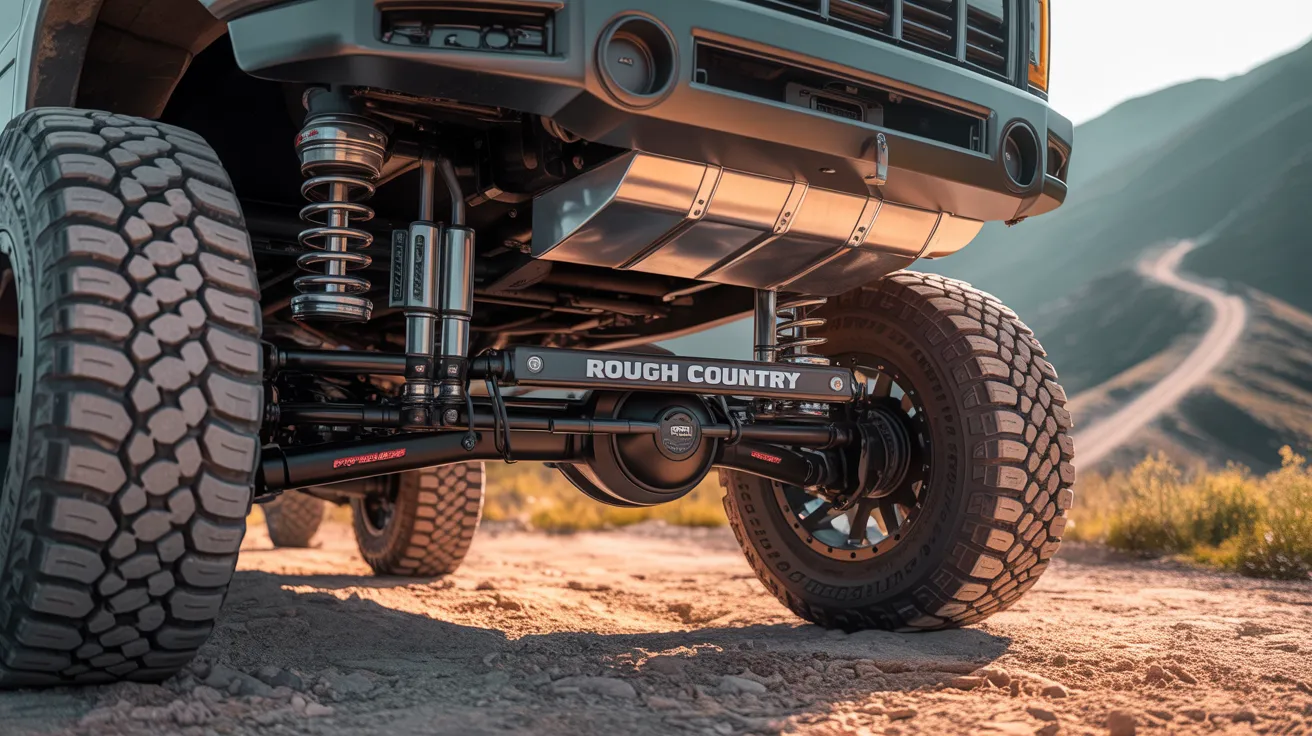
A suspension lift kit raises the whole truck and modifies critical parts to create more clearance and wheel travel. You'll see larger improvements in ride height, off-road performance, and tire options, but you should anticipate handling tradeoffs, steering changes, and a higher center of gravity. If you want mild visual correction, level it. If you need real clearance and articulation, use a suspension lift and design the supporting mods based on your needs.
Find the Rough Country lift kit that matches your truck.
Kick off by documenting your truck's year, manufacturer, and model, powertrain, and planned use, as Rough Country builds lift kits based on precise geometric specifications and capability targets. That foundation shows you which structural parts and hardware will mount properly without clearance or alignment issues.
Start by checking stock ride height, cabin and cargo bed setup, axle specification, and if your truck runs 2WD, 4WD, or adaptive suspension. Rough Country fitment resources simplify this process, but you must verify trim compatibility against trim-level parts and OEM package variations. A kit made for a Silverado 1500 may not fit a Trail Boss, and a Ram with air suspension needs different accommodations rather than a coil-spring vehicle. By confirming exact fitment upfront, you sidestep fitment surprises, compatibility issues, and returns.
Determine which Rough Country lift kit matches your driving habits.
Match the kit to your driving patterns, and you'll get better ride quality, lasting performance, and tire space without purchasing unnecessary capability. If you primarily commute in your truck, choose a simple Rough Country leveling kit or a 2 to 3.5 inch lift kit tuned for daily comfort and consistent steering feel.
If your truck sees both pavement and trail time, go with a lifted suspension featuring improved shocks and corrected arm angles. You'll gain improved trail handling, superior articulation, and capacity for bigger tires without overstressing stock components. For extensive off-road use, select raised struts, Rough Country N3 or Vertex dampers, and kits that maintain driveline angles under compression. The right Rough Country package should align with cargo load, speed, and terrain, and your tolerance for ride stiffness.
Best Rough Country Truck Accessories
Enhance your lift setup including Rough Country upgrades that tackle the real weak points you'll notice after changing ride height, tire size, and vehicle stance. Focus on upgraded entry steps or side sliders, which regain ease of cabin entry and offer side protection when your truck sits higher and wider.
Next, address visibility and control. Rough Country LED lightbars improve usable sightlines on dim trails, jobsites, and remote roads without complex setup. Seat protectors and floor liners protect inside surfaces from mud, stones, and water you'll carry in after off-roading. Fender extensions manage tire throw and match the expanded stance created by larger tires. For towing and recovery work, commercial-grade hitches, tow hooks, and bumpers that support winches deliver function without impacting compatibility. Pick add-ons that complement your lifted truck's dimensions and load capacity.
How Much Should You Budget for Your Build?
After selecting the suspension lift and supporting accessories, allocate a budget beyond the base price. You'll require money for shock units, wheel sets, tire options, alignment work, labor, and any drivetrain or steering corrections your platform requires. Maker reputation counts; quality kits usually offer stricter specs, better ride quality, and easier installations.
In terms of realistic budget ranges, expect entry-level spacer or leveling systems to begin at lower costs, whereas full suspension systems with control arms, tuned dampers, and larger tires climb quickly. Installation complexity, shop rates, and recalibration work may contribute significantly. You should also price supporting upgrades like gear changes, brake components, and recovery gear if you're building for trail use. When finances are limited, weigh financing options cautiously and prioritize durability instead of fancy additions.
Questions You Might Have
Do Lift Kits Impact Factory Warranty?
Yes, lift systems could impact your factory warranty coverage, yet they won't necessarily void it. You may face warranty implications if the dealer establishes your lift modification caused or contributed to a failure. Drive system, steering, suspension, and drivetrain disputes often trigger dealer disputes. You should keep installation documents, use quality components, and keep service intervals. This helps you dispute declined claims and protect coverage if the modification isn't responsible.
Do Larger Tires Require Re-Gearing My Truck?
Yes—if you jump multiple tire sizes, you'll often need re-gearing. Consider moving from 31s to 35s, for example—your truck can feel sluggish, shift irregularly, plus create drivetrain pressure under load. Re-gearing restores effective gear ratios, allowing you to get back acceleration, towing performance, and transmission behavior. You may not require regearing for small tire upgrades, however if performance, economy, or shifting decline, it's typically the right decision.
How Often Should Lift Kit Components Be Inspected?
You must examine lift system components once 500 miles are reached, then per oil change or every 3,000 to 5,000 miles, depending on your driving habits. Periodic inspections assist you in catch bushing wear, leaking shocks, bracket issues, and alignment problems soon. Test bolt tension post-rough terrain, towing situations, or impact events. When operating through mud, salt, or difficult terrain frequently, shorten intervals and look at steering and suspension parts more frequently.
Does a lift kit impact your vehicle's towing and payload limits?
Yes, a suspension lift can modify your towing and payload capacity. When you raise ride height for more ground clearance, you change suspension geometry, center of gravity, and leverage on components. That can reduce stability under load and add drivetrain strain, most notably with bigger tires. You should follow your factory specifications unless an quality-engineered kit explicitly states revised capacities. Correct alignment, transmission ratios, and brake performance count as well.
Do alignment checks Need attention after installing truck add-ons?
Yes—if accessories adjust height of ride, suspension geometry, steering angles, or tire measurement, you must have an alignment. You'll witness the reality fast: slight changes can pull your truck explore article off-center, scrub tread, and compromise handling. A proper wheel alignment corrects camber angle value, caster, and toe angle value to spec. After certain modifications, you should also arrange brake system calibration for autonomous driver system accuracy. You protect tire life, steering precision, and real-world safety by checking alignment immediately.
Summary
Choosing the right lift configuration and products comes down to your truck's application, what stance you want, and what your budget can handle. When you match a Rough Country lift kit within your driving approach, you'll experience durability, space, and aesthetics that work together like a well-tuned drivetrain. Integrate smart accessories, structure your spending carefully, and you'll build a rig remaining practical on the road, capable off it, and ready for whatever job comes next.